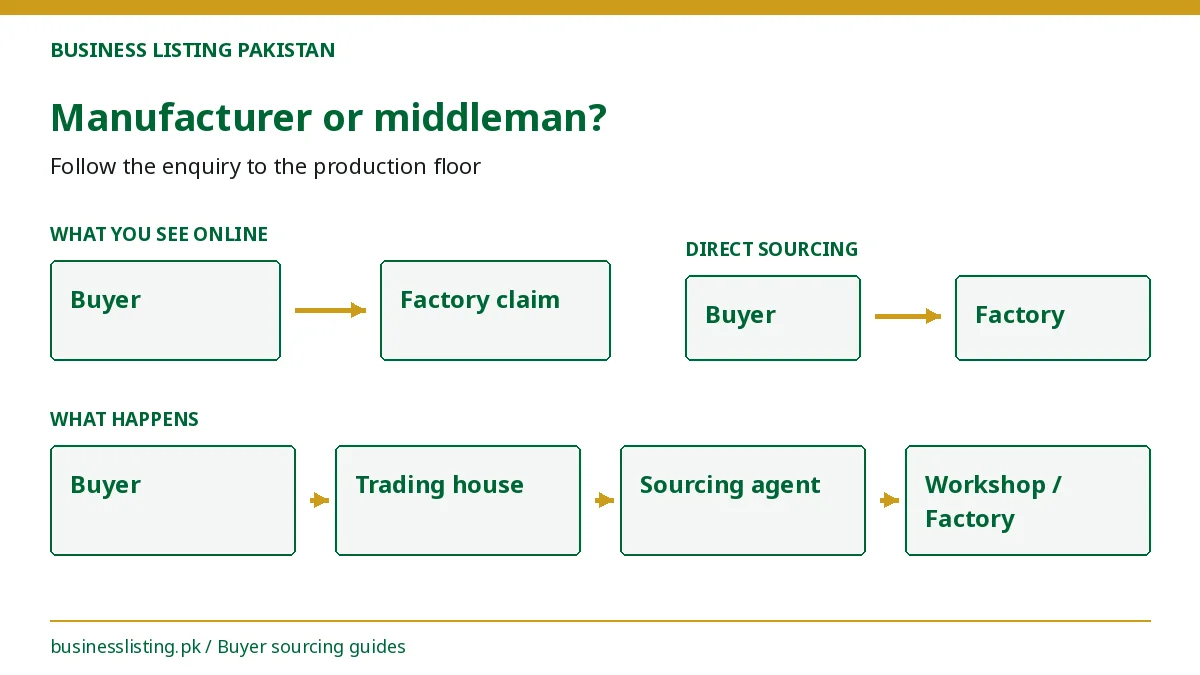
Picture a typical scenario. A buyer in Manchester types Pakistani manufacturers into Google, opens three directories and emails eight "factories" about 5,000 pairs of leather work gloves. By the next morning there are six quotes in the inbox. Two of them come from the same Sialkot workshop, sent through two different trading houses. One price is 30% below the others and comes from a company that, on a video call, turns out to be a two-person office with no machines at all.
This is the most common complaint we hear from importers who source from Pakistan. Pakistan is not short of factories: the country exported $32.1 billion of goods in FY2025, according to the Pakistan Bureau of Statistics. The real issue is that genuine Pakistani manufacturers are hard to tell apart from middlemen online. This guide explains why that happens, what it costs you, and a practical seven-step method to find and verify the real factory behind a product.
Why finding real Pakistani manufacturers online is harder than it should be
There are four structural reasons, and none of them is about bad intentions.
1. Many of the best factories are invisible online
Pakistan's export industry is built on clusters of small and medium-sized family firms. Sialkot alone has more than 25,000 firms associated with its Chamber of Commerce and Industry, and the city's SMEs earn over $2.5 billion a year in foreign exchange, according to a September 2026 report by the Associated Press of Pakistan. Many of these workshops have run for two or three generations on repeat orders from the same overseas customers. They never needed a website, so a Google search rarely finds them directly.
2. Directories reward the word "manufacturer"
Most B2B portals let a company tick "Manufacturer" without any check. Trading houses know buyers filter for it, so many tick the box. The result is a search page where an exporter with no machines looks identical to a factory with 400 workers.
3. Copied lists and stale data
A large share of the "lists" circulating online were scraped years ago and copied from site to site. Phone numbers ring a shop that closed in 2019; email addresses bounce. Buyers waste their first week cleaning bad data instead of talking to suppliers.
4. Production is often legitimately split across workshops
In sectors like surgical instruments and sports goods, forging, grinding, stitching or polishing are often done by specialist sub-contractors before final finishing and quality control at the exporting firm. That is normal and efficient, but it means the question is not only "is this a factory?" but "who controls quality before shipment?"
What the middleman problem actually costs a buyer
Trading companies are not the enemy, and later we explain when they are the right choice. But when a buyer believes they are talking to Pakistani manufacturers and they are not, the costs show up in five places:
- Price: every extra layer adds a margin, and you cannot negotiate on production cost you cannot see.
- Specification drift: technical questions about leather grade, steel type or GSM are relayed second-hand, and answers come back vague.
- Quality control: the sample you approved may come from one workshop and the bulk order from another.
- Compliance: certificates such as ISO 13485 or BSCI may belong to a different legal entity from the one invoicing you, which can fail your own customer's audit.
- Continuity: if the intermediary disappears, you lose the relationship with the factory as well.
Where Pakistani manufacturers are actually concentrated
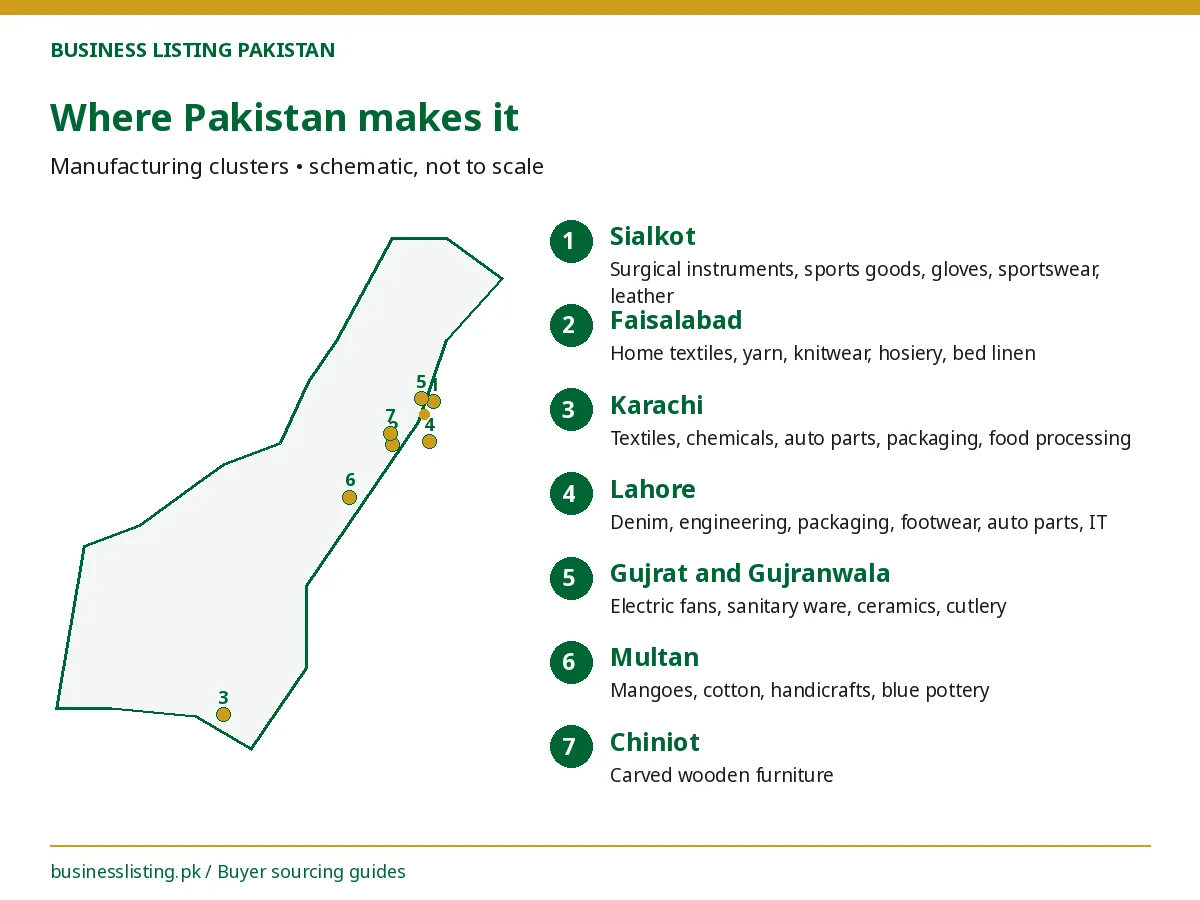
Knowing the clusters is the fastest way to filter. A "football factory" based in a city with no sports-goods industry deserves a closer look. The table below summarises the main manufacturing hubs and what they are known for.
| Cluster | Main products | Useful context |
|---|---|---|
| Sialkot | Surgical and dental instruments, sports goods, footballs, gloves, sportswear, leather apparel | 25,000+ firms linked to the local chamber; around 99% of local production is exported (APP, 2026) |
| Faisalabad | Home textiles, yarn, knitwear, hosiery, bed linen | Core of Pakistan's textile chain |
| Karachi | Textiles and garments, chemicals, auto parts, packaging, rice and food processing | Main port city; many head offices of large exporters |
| Lahore | Denim and apparel, engineering, packaging, footwear, auto parts, IT | Large industrial estates along the Lahore–Sheikhupura corridor |
| Gujrat and Gujranwala | Electric fans, sanitary ware, ceramics, cutlery (nearby Wazirabad) | The two regions hold nearly 90% of Pakistan's domestic fan manufacturing capacity (Pakistan Business Council) |
| Multan | Mangoes, cotton, handicrafts, Multani blue pottery | Agricultural and craft hub of southern Punjab |
| Chiniot | Carved wooden furniture | Traditional furniture-making town |
Textiles dominate the export basket: textile exports reached $17.89 billion in FY2025, up 7.39% year on year (PBS), which is roughly 56% of all goods exports. If you are sourcing apparel or home textiles, you will find the deepest pool of Pakistani manufacturers in Karachi, Lahore and Faisalabad.
How to verify Pakistani manufacturers: a 7-step checklist
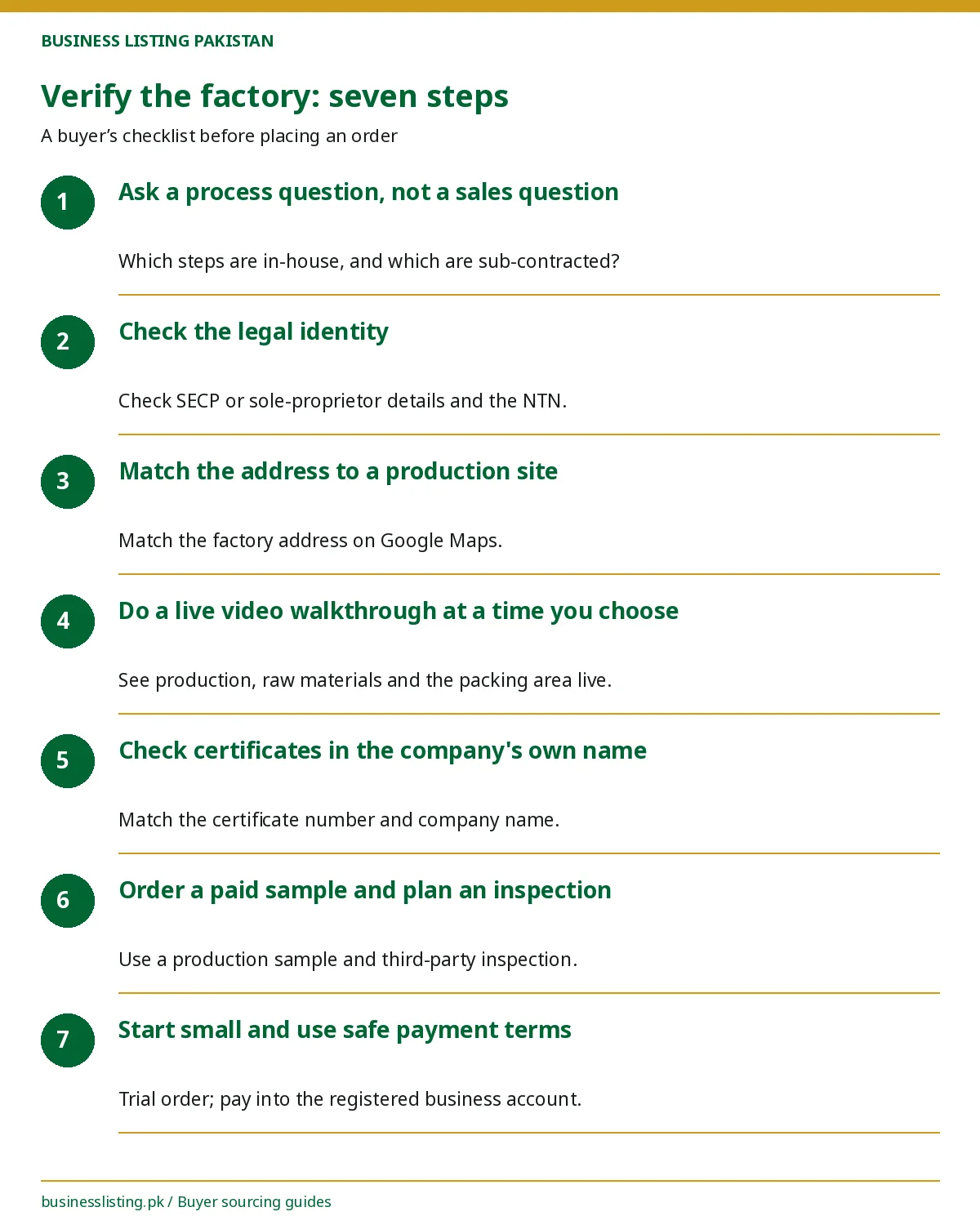
You do not need to fly to Pakistan to separate a real factory from a reseller. These seven steps take a few days and cost very little.
Step 1: Ask a process question, not a sales question
Instead of "Are you a manufacturer?", ask "Which production steps happen in your own building, and which are sub-contracted?" A real factory answers in detail: cutting, stitching and packing in-house, embroidery outsourced, and so on. A trader usually answers in general terms.
Step 2: Check the legal identity
Ask for the company's SECP registration (for a private or public limited company) or its sole-proprietor details, and its National Tax Number. You can confirm that an NTN is on the Federal Board of Revenue's Active Taxpayer List online. Chamber of commerce membership, for example with the Sialkot, Lahore or Karachi chamber, is another useful signal.
Step 3: Match the address to a production site
Put the factory address into Google Maps. Industrial estates and factory roofs are easy to recognise from satellite view; a shop in a commercial plaza is not a stitching unit for 50,000 garments a month.
Step 4: Do a live video walkthrough at a time you choose
Ask for an unscheduled video call from the production floor. Ask the person to show the machine making your product type, the raw material store and the packing area. Pre-recorded factory videos can be borrowed; a live call is much harder to fake.
Step 5: Check certificates in the company's own name
For surgical instruments look for ISO 13485 and, for Europe, CE technical files; for apparel and textiles, BSCI/amfori, Sedex, WRAP or OEKO-TEX; for general quality, ISO 9001. Check that the certificate number and company name match on the issuing body's online database.
Step 6: Order a paid sample and plan an inspection
Pay for a sample made on the production line, not taken from a showroom. For the first bulk order, budget for a third-party pre-shipment inspection by a firm such as SGS, Bureau Veritas or Intertek.
Step 7: Start small and use safe payment terms
Begin with a trial order. Use a letter of credit or a split such as 30% advance and 70% against shipping documents, and always pay into a business account in the company's registered name, never a personal account.
Red flags to watch for
- The catalogue mixes unrelated products, such as footballs, basmati rice and surgical scissors, all "manufactured in-house".
- The supplier will not share a factory address or join a live video call.
- The price is far below every other quote for the same specification.
- Certificates are in a different company's name, or have expired.
- Payment is requested into a personal bank account or a third-country account.
When a trading company is the right choice
To be fair to Pakistan's trading houses: they solve real problems. If you need a mixed container from several factories, low order quantities that a large mill will not accept, or someone on the ground to consolidate and inspect, a good sourcing agent or exporter earns their margin. The key is transparency. A trustworthy trader will tell you they are a trader, explain which Pakistani manufacturers they work with, and let you inspect production.
How Business Listing Pakistan helps you reach Pakistani manufacturers directly
We built Business Listing Pakistan to fix exactly this problem. Every company profile shows its stated business type, city, year established, products and verification level, and listings we created on a company's behalf carry a clear "Unclaimed" badge until the owner claims them. You can browse Pakistani manufacturers by industry and city, compare profiles side by side, and send one buying request that relevant suppliers in that category can quote on, free of charge.
If you want a ready starting point, our Pakistani manufacturers list for 2026 groups listed factories by industry and city.
The bottom line
Pakistan has a deep, export-focused manufacturing base, from Sialkot's surgical and sports clusters to the textile mills of Faisalabad and Karachi. The challenge is not finding Pakistani manufacturers but proving that the company in your inbox is one. Ask process questions, check the legal identity, see the production floor live, and start with a small, inspected order. Do that, and you will build supplier relationships that last for years.
Sources: Pakistan Bureau of Statistics trade data for FY2025, as reported by the Associated Press of Pakistan (July 2025); APP report on Sialkot's export industry (September 2026); Pakistan Business Council, "Enhancing the Competitiveness of Pakistan's Domestic Fan Industry".